10/05/2026 • by Jonas Kellermeyer
From Routine Disruptions to Loneliness: What Everyday Patterns Can Reveal About Social Participation

Sensors can detect events that indicate changes in everyday routines. What they cannot reveal is why those changes occur. The following article explores how much meaning can reasonably be attributed to such disruptions in routine.
A person leaves their home less often. The front door stays closed on mornings when it used to open regularly. The kitchen light stays on later than usual. For a sensor-based assistance system, this is a clear signal: something has changed. What exactly, however, remains uncertain. Perhaps a friend has passed away. Perhaps a knee injury is making it harder to get out. Or perhaps the person has simply decided to spend their mornings with a good book instead.
This is precisely the point at which technology either becomes a meaningful bridge against social isolation – or remains little more than an empty promise. The path from an objectively observable disruption in routine to its subjective social meaning is longer than data models would often like it to be. It is worth tracing that path step by step.
The Promise of Unobtrusive Observation
Ambient Assisted Living (AAL) has long been built around an appealing idea: if sensors can quietly accompany everyday life, they may be able to detect when support is needed before a person has to ask for it themselves. Passive infrared (PIR) motion sensors and door contacts can do this without cameras or vital-sign data. That makes them relatively data-minimizing and, in many cases, more acceptable to users.
Research has already extended this idea to the topic of loneliness. Austin et al. (2016), for example, examined whether loneliness among older adults could be estimated from passively collected smart-home data, including time spent outside the home. The basic idea is plausible: people who withdraw socially may also move differently through their daily lives.
The difficulty lies in the direction of the inference. The fact that lonely people, on average, may leave the house less often does not mean that someone who goes out less frequently is necessarily lonely or socially isolated. Group-level statistics do not automatically justify interpreting an individual life in the same way. Yet for a system operating in a specific person’s home, it is precisely this individual interpretation that can become the critical case.
Isolation, Loneliness, and Social Participation: Three Different Concepts
In everyday language, these terms are often used interchangeably. For the design of technical systems, this is problematic because each refers to something different.
Social isolation describes an objective condition: few contacts, a small social network, and infrequent encounters. Loneliness describes a subjective experience. Perlman and Peplau (1981) define it as an unpleasant experience that arises when a person’s social relationships fall short of what they desire, either quantitatively or qualitatively. Weiss (1973) further distinguishes between emotional loneliness, meaning the absence of a close attachment figure, and social loneliness, meaning the absence of a supportive social environment.
Loneliness is the perceived gap between the relationships a person has and those they would like to have. Isolation refers to the measurable size and extent of a person’s social network. The two may coincide, but they do not have to.
Finally, participation shifts the focus away from the network itself and towards intersubjective interaction. In its International Classification of Functioning, Disability and Health (ICF), the World Health Organization defines participation as “involvement in a life situation” (WHO, 2001). Social participation accordingly refers to engagement in activities that enable encounters and interaction with others – from a brief conversation at the local bakery to joining a choir, volunteering, or becoming involved in one’s neighborhood (see Levasseur et al., 2010). Unlike social isolation, participation does not merely count social contacts; and unlike loneliness, it is not primarily concerned with individual experience. It describes whether a person is able and willing to take part in social life. It is therefore also the concept that most clearly extends beyond the individual: whether participation is possible depends on the barriers and opportunities within a person’s environment – from a discontinued bus route to the closure of a neighborhood meeting place.
The implication is inconvenient. Someone can live alone, receive few visitors, and still be perfectly content. Conversely, someone can be surrounded by family and still feel profoundly lonely. At best, sensors in the home can capture only traces of isolation. Since we are dealing with individuals, the same behavior can also arise from very different motivations. The subjective experience that ultimately matters lies beyond the reach of sensors.
Transitions and Biographical Disruptions as the True Points of Risk
A look at the consequences shows why the effort is still worthwhile. In a meta-analysis by Holt-Lunstad et al. (2015), both social isolation and loneliness were associated with an increased risk of mortality. In other words, this is about more than subjective well-being alone.
Social withdrawal rarely emerges out of nowhere. It typically becomes visible at transition points where previously stabilizing structures begin to fall away:
- Widowhood or the loss of close friends,
- Retirement and the loss of work-related social contacts,
- Reduced mobility, for example due to illness or the loss of a driver’s license,
- Moving home, whether to a smaller apartment or closer to one’s children,
- Changes in the social fabric of the neighborhood.
These transitions have long been examined in longitudinal studies of aging, such as the German Ageing Survey (DEAS) conducted by the German Centre of Gerontology (DZA). For technology development, this is a valuable resource. Knowing which transitions make social withdrawal more likely means that not every deviation in everyday life has to be treated the same way. A system can look for disruptions that fit known patterns instead of reacting to every delayed breakfast or every change in television use.
What Sensors Can See — and What They Cannot
An infrared sensor detects movement. A door contact detects when a door opens and closes. Everything beyond that is interpretation. The following overview shows just how widely the possible meanings of a single signal can vary.
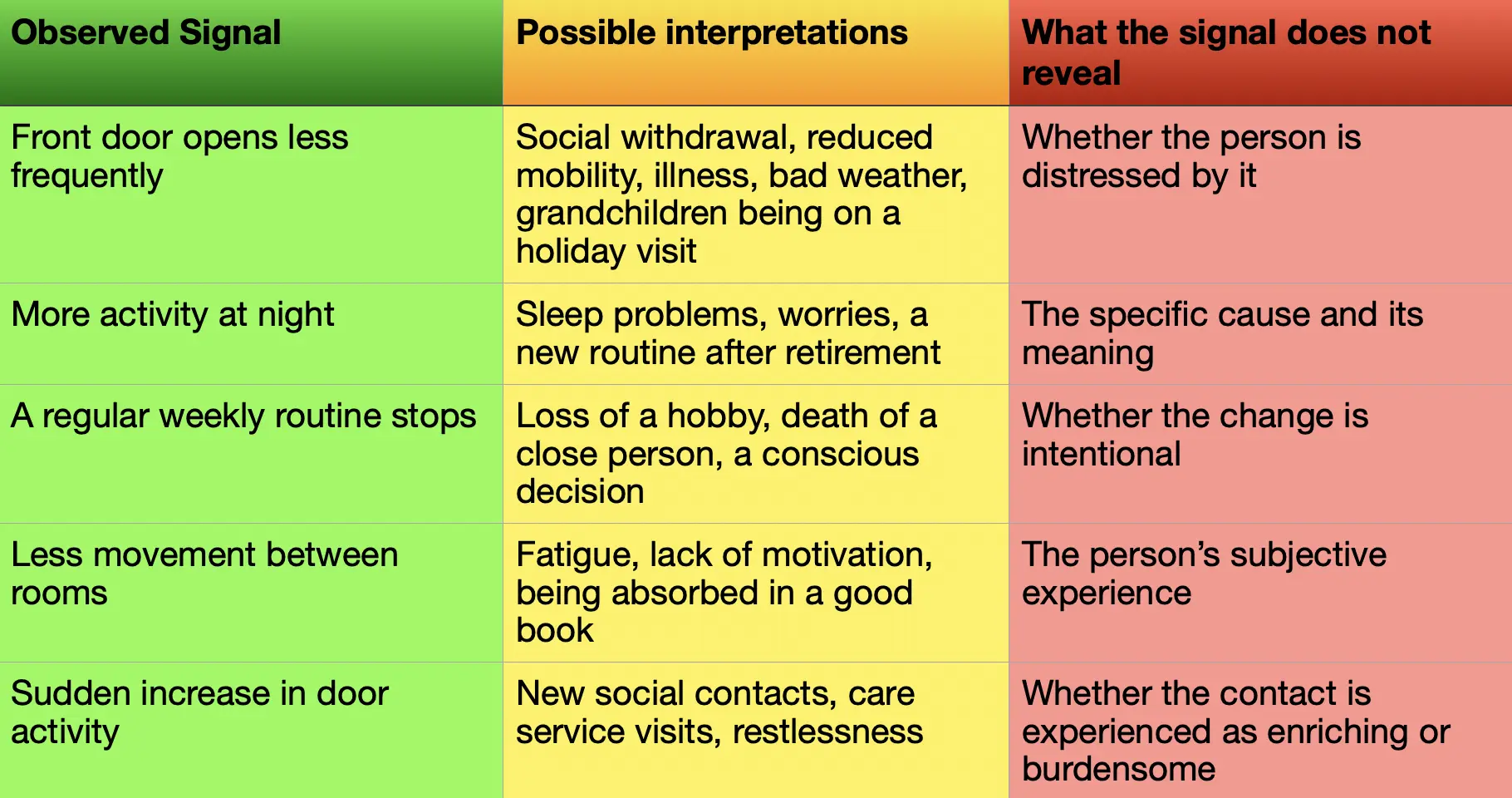
This is further complicated by another finding. According to socioemotional selectivity theory (Carstensen, 1992), many people deliberately reduce the size of their social networks as they age. They focus on a smaller number of emotionally meaningful relationships. In such cases, fewer social contacts reflect a conscious choice rather than a warning sign. A system that interprets every decline in activity as a risk would systematically patronize these individuals and amount to an argumentative shortcut.
Three Options for Dealing with Ambiguity
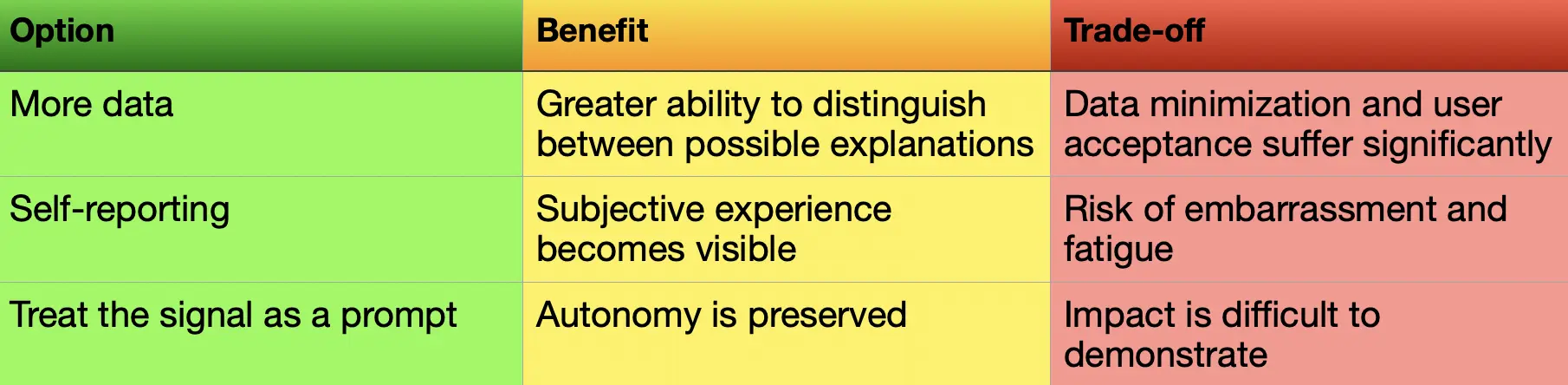
Anyone building such a system has to decide how to deal with the real gap between signal and meaning. There are three main options, and each comes at a cost.
1. Collect more data
The obvious reflex is this: if a single signal is too ambiguous, add more. Electricity consumption, voice activity, humidity and temperature, vital signs, environmental data. With each additional source, the system becomes better able to distinguish between possible explanations. But with each source, the feeling of being observed – of becoming almost completely transparent – also increases. The principle of data minimization, which is one of the reasons such systems are acceptable in the first place, is gradually undermined. The result may be a more accurate system that hardly anyone would want in their home. In research settings, this kind of approach is common. But if the goal is to offer a real product, other measures should be considered.
2. Combine the signal with self-reporting
The second approach brings the person themselves into the process. When the system detects a change, it asks for clarification and tries to reduce the ambiguity in this way. A measurement thus becomes a dialogue, giving the person’s subjective experience a voice. The trade-off is that every follow-up question is an intervention and may become annoying over time. If phrased poorly, it can also create feelings of embarrassment or shame. This is especially important because loneliness remains a highly stigmatized topic that many people are reluctant to talk about. Any such interaction therefore needs to be handled with particular care.
3. Treat the signal as a prompt
The third approach deliberately avoids making a diagnosis. Instead, the system treats a disruption in routine as a prompt for a low-threshold offer: a reminder of a familiar activity, a suggestion to contact someone, or an opportunity in the local neighborhood. Whether the person chooses to act on it remains entirely up to them. This approach is challenging precisely because it accepts a degree of ambiguity. In other words, such a system can never say with certainty whether it has actually helped.
Position: Routine Disruptions as a Starting Point for Conversation
This assessment leads to a clear recommendation. A disruption in routine can serve as a prompt, but not as a reliable finding in itself. Systems designed to address social isolation should therefore make the third approach their foundation, while carefully supplementing it with the second. In everyday life, collecting more data is rarely the answer to a question that is fundamentally about meaning.
This leads to three design principles:
- Transitions before deviations. The system gives greater weight to disruptions that align with known risk transitions than to random fluctuations. This reduces false alarms and builds on robust findings from ageing research.
- Offer before judgment. Microinteractions do not assign a diagnosis. They open a door and leave the decision with the person. Anyone who chooses not to engage does not have to justify that choice.
- Transparency before seamlessness. The person knows what the system records, why it is responding, and how it can be switched off if needed. Explanations in plain language can build more trust than technology designed to remain as invisible as possible (see Ehsan et al., 2024).
The drawback of this position ultimately lies in evaluation. If a system deliberately avoids making diagnoses, it needs different criteria for measuring success. This may be one of the most important tasks for collaboration between technology development and the social sciences. Which scales measure loneliness reliably, such as the instruments developed by de Jong Gierveld? Which study designs can demonstrate impact without undermining participants’ autonomy? And how can synthetic test data be calibrated against real trajectories from survey research so that they amount to more than a semi-plausible fiction?
Conclusion
Everyday patterns can tell us a great deal about the fact that a person’s life is changing. They reveal far less, however, about what that change actually means. A front door that opens less often is a data point. Whether it reflects grief, a bad knee, or a consciously quieter phase of life is something only the person themselves can know.
For the design of assistive systems in the context of AAL, this means that modesty and deliberate restraint are meaningful design choices. A system that treats disruptions in routine as a prompt for a voluntary offer respects the boundary between what can be measured and what can be experienced. It draws on knowledge about life transitions to become more context-sensitive, while remaining open to the possibility that reduced social contact may sometimes simply be intentional.
The real work begins where technology development and ageing research start looking for synergies. Anyone building on technical signals needs the knowledge of those who study meaning, and vice versa. We have already explored how synthetic data can be used responsibly in this context in our Deep Dive on synthetic data analysis.
Sources
Austin, Johanna; Dodge, Hiroko H.; Riley, Thomas; Jacobs, Peter G.; Thielke, Stephen & Kaye, Jeffrey (2016): A Smart-Home System to Unobtrusively and Continuously Assess Loneliness in Older Adults. IEEE Journal of Translational Engineering in Health and Medicine 4.
Carstensen, Laura L. (1992): Social and Emotional Patterns in Adulthood: Support for Socioemotional Selectivity Theory. Psychology and Aging 7 (3), 331–338.
De Jong Gierveld, Jenny & van Tilburg, Theo (2006): A 6-Item Scale for Overall, Emotional, and Social Loneliness. Research on Aging 28 (5), 582–598.
Ehsan, Upol; Liao, Q. Vera; Passi, Samir; Riedl, Mark O.; Daumé, Hal (2024): Seamful XAI: Operationalizing Seamful Design in Explainable AI. In: Proceedings of the ACM on Human-Computer Interaction, Volume 8, Issue CSCW1, 1–29.
Holt-Lunstad, Julianne; Smith, Timothy B.; Baker, Mark; Harris, Tyler & Stephenson, David (2015): Loneliness and Social Isolation as Risk Factors for Mortality: A Meta-Analytic Review. Perspectives on Psychological Science 10 (2), 227–237.
Levasseur, Mélanie; Richard, Lucie; Gauvin, Lise & Raymond, Émilie (2010): Inventory and Analysis of Definitions of Social Participation Found in the Aging Literature: Proposed Taxonomy of Social Activities. Social Science & Medicine 71 (12), pp. 2141–2149.
Perlman, Daniel & Peplau, Letitia Anne (1981): Toward a Social Psychology of Loneliness. In: Duck, Steve & Gilmour, Robin (Hg.): Personal Relationships 3: Personal Relationships in Disorder. Academic Press, London.
Weiss, Robert S. (1973): Loneliness: The Experience of Emotional and Social Isolation. The MIT Press, Cambridge, Massachusetts.
World Health Organization (2001): International Classification of Functioning, Disability and Health (ICF). WHO, Genf.
About the author
As a communications expert, Jonas is responsible for the linguistic representation of the Taikonauten, as well as for crafting all R&D-related content with an anticipated public impact. After some time in the academic research landscape, he has set out to broaden his horizons as much as his vocabulary even further.
