Lab Project #2 – Digital Bridges
Social Isolation in Later Life and Ways to Address It


Partner
ZIM (Zentrales Innovationsprogramm Mittelstand)
2026 - 27
Topics in Focus
Adaptive interfaces
Artificial Intelligence (AI)
Artificial Intelligence of Things (AIoT)
Digital sociotechnics
UX research
Social isolation is a condition that particularly affects people in later life. There are many causes behind this phenomenon that go far beyond purely technology-driven factors: changes in one’s social environment, health limitations, reduced mobility, the loss of work or a partner, as well as physical distance from family and friends can all lead to less frequent contact and make participation in social life more difficult.
Against this backdrop, we ask a central question: How can digital bridges be built that sustainably strengthen a sense of belonging, active participation, and shared experiences in later life? And which key factors need special attention when addressing this challenge?
Intelligent assistive systems can be an important building block in tackling social isolation. They are already widespread and promise closeness across distance. At the same time, everyday experience shows that digital means of communication do not automatically create a sense of connection—especially when solutions fail to align with the lived realities of older adults or even reinforce existing barriers.
With our project “Digital Bridges,” we therefore approach the topic holistically. We seek to understand which factors contribute to social isolation in later life, which resources and routines enable connection, and how to design user-centered interventions based on these insights – interventions that foster genuine encounters, orientation, and social inclusion. The goal is to enable authentic communal experiences through the deliberate combination of technology and thoughtful design.
Phase 1: From Understanding to System Architecture
In the first phase of our project, we laid the foundation for developing a digital assistive solution to reduce social isolation. The focus was not on rushing into the implementation of individual features, but on precisely shaping a robust overall concept. This included refining the terminology we use by creating a coherent glossary, as well as conducting initial research into the lived realities of older adults.
Which situations intensify the feeling of isolation? Which routines provide stability? Which barriers – physical, social, or digital – make participation in everyday life more difficult, and with it interpersonal connection?
Through a systematic analysis of the existing research literature, we identified a promising approach to reducing social isolation: one that should not focus exclusively on older adults, but instead aims to break down rigid generational boundaries.
Phase 2: From Raw Data Points to Preventive Protection Against Social Isolation
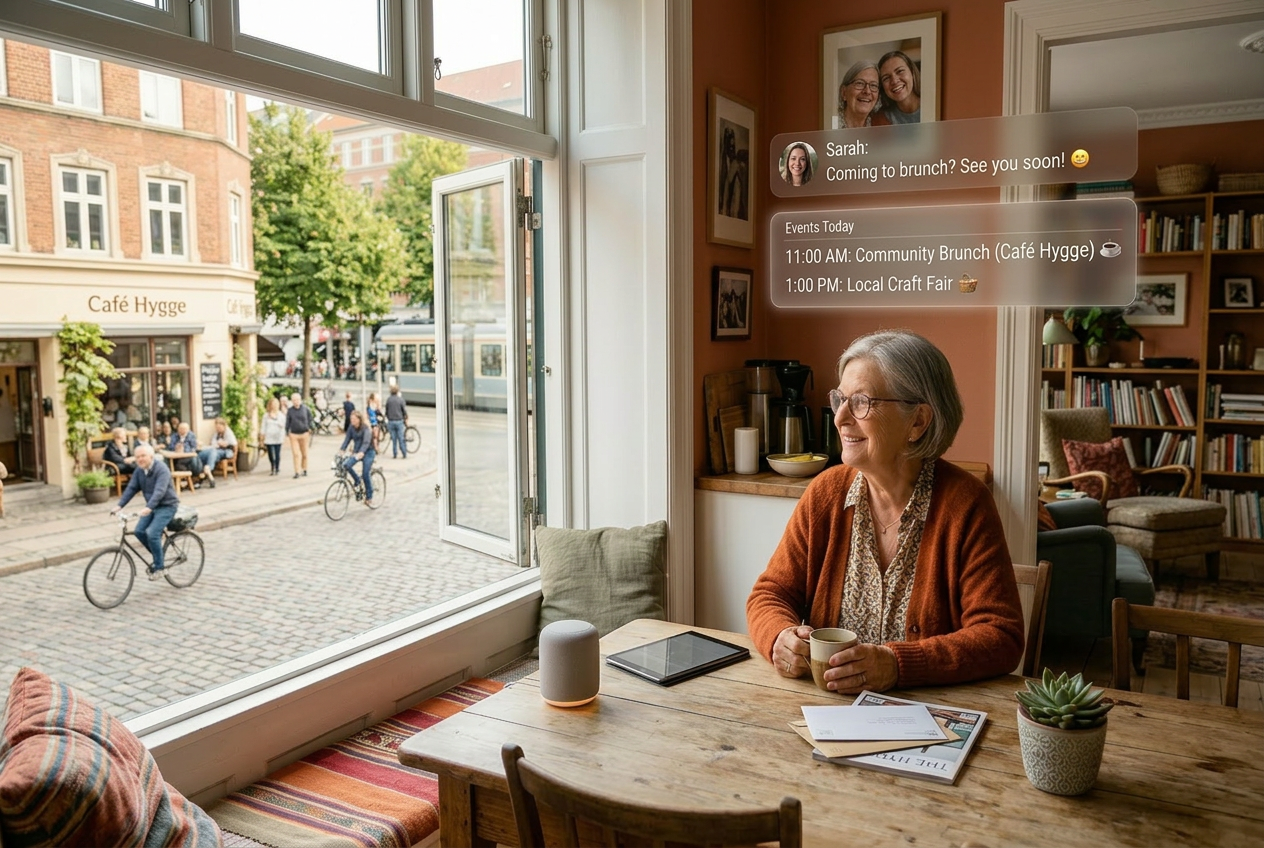
In phase 2, we currently focus on the prototypical development of an MVP that goes far beyond the functional logic of conventional assistance systems. By combining location-based IoT sensor technology with adaptive algorithms, raw data is to be transformed into context-sensitive feedback and thereby generate tangible effects. Alongside the research into suitable sensors, the epistemological dimension of the data being collected is always at stake as well: What do raw data actually reveal about the condition of the subjects being measured? What kinds of conclusions do they allow? And where do we encounter practical limits in implementation?
The anticipated AAL (Ambient Assisted Living) system does not merely respond to emergencies, but is intended to enable proactive action within the home environment. By recognizing and evaluating behavioral patterns in real time, tendencies toward isolation can be addressed at the very point where they begin to emerge. In this way, the system adapts dynamically to the individual daily rhythms of its users – always with the aim of actively fostering social participation and counteracting social isolation in a preventive manner.
Phase 3: Exchange with Different Stakeholder Groups
Because the development of a prototype never takes place in a vacuum, but should always resonate with the plural society in which it is ultimately meant to have an impact, we set out to take the pulse of public sentiment around the topic of Digital Bridges across three different events.
This triad of events consisted of a visit to a neighborhood gathering hosted by Berliner Volkssolidarität, participation in the Ageing with Tech Festival organized by Hamburg’s Körber Foundation, and attendance at the innovation event Waterkant in Kiel. Each of these three events brought together a different audience: seniors aged 70+ at the neighborhood gathering, civil society actors and NGOs at the Ageing with Tech Festival, and start-ups and innovation-driven professionals at Waterkant. As diverse as these stakeholder groups were, so too were their reactions to technological interventions in social settings. Broadly speaking, it can be said that people who are themselves affected tend to paint a consistently bleak picture of the technologically saturated present in contrast to those individuals that are currently active in the peak of their lives.