05/21/2026 • by Shirley Schmolke
Co-Creation as a Development Engine
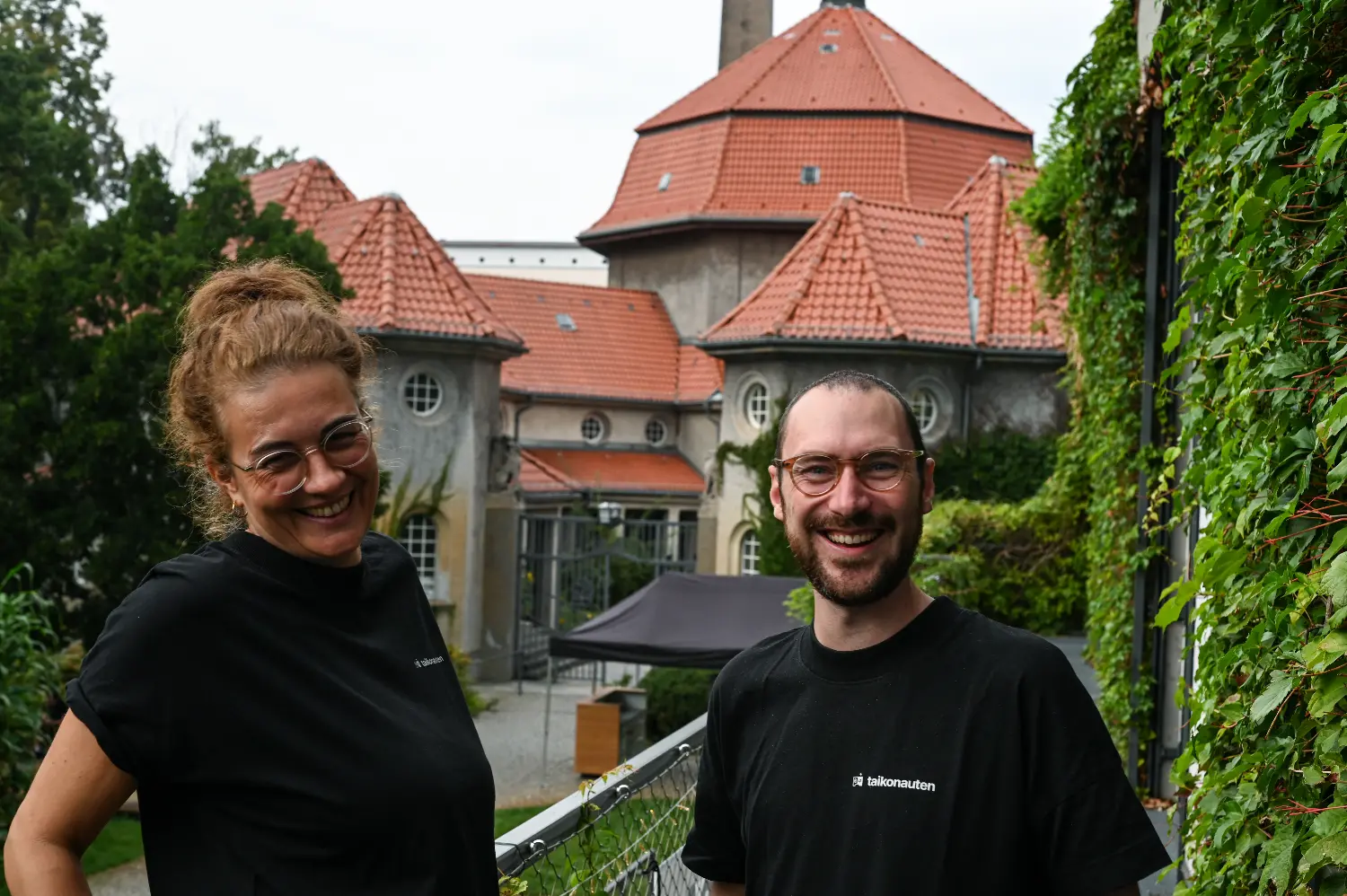
How do we ensure that futures research translates into truly effective products? Co-creation is the central building block, applied from the first sketch straight through to the prototype. Using our "Digitale Brücken" (Digital Bridges) project as a case study, Lisa (Lead Transformation Strategist) and Sascha (AI Transformation Manager) explain why new approaches need the friction of reality and what co-creation looks like in practice.
Research beyond data
Shirley: Lisa, Sascha, this summer you are bringing your workshop "What if…? Aging, Technology, and Social Proximity in 2035" to conferences and festivals, including the Ageing with Tech Festival 2026 and the Waterkant Festival. How did this come about?
Lisa: We are currently working on the ZIM-funded project "Digitale Bridges" in our R&D Lab. Our focus is on social isolation in old age, exploring how we can use AIoT technology to counter it preventively. This is a complex topic that affects every single one of us. After all, we are the older generation of tomorrow, and our children are the generation of the day after. Navigating this requires a human-centered mindset and real co-creation. For our team, this means we refuse to develop products in a vacuum or isolated within our R&D Lab. Instead, we bring multifaceted perspectives and real needs straight to the design table. We have utilized surveys and interviews from the very start, and integrating co-creation is the next logical step.
Sascha: Exactly. While surveys and user interviews provide valuable data, a collaborative workshop delivers real, vivid discourse. It gives us the space to examine and advance concrete practical examples from diverse perspectives. This significantly reduces the risk of building at full speed past real human needs. At the same time, this approach inspires people to embrace an exploratory, strategic mindset. We motivate them to systematically question the status quo and actively shape the digital future instead of just waiting for it to happen.
Social Isolation, a System Failure
Shirley: What makes the topic of social isolation so challenging in your view?
Lisa: Social isolation is a structural system failure. Personal shortcomings play no role here. Today, we are globally connected around the clock and options are endless. Yet, surveys consistently show that many people no longer know their immediate neighbors and feel increasingly lonely. In old age, the risk of social isolation intensifies due to factors like losing loved ones. This is a measurably hazardous state that burdens both the individuals affected and the healthcare system. No matter which layer of the issue you analyze, you encounter interlocking problem spaces.
Sascha: The complexity is heightened because the warning signs so often go unnoticed. This is why we place a sharp focus on prevention. Furthermore, the general attitude within both society and the industry presents a barrier. "Help" is typically understood as one-sided charity, which inherently creates a dependency. We believe true reciprocity is needed. We aim for symbiotic relationships where all participants are simultaneously givers and takers. Supporting this social dynamic technologically without suffocating human proximity is a profound strategic task.
A Social Operating System: The UsOS Concept
Shirley: What exactly do you mean by symbiotic relationships? Do you already have a conceptual framework that you bring into the workshops?
Sascha: We have gathered extensive insights in this field over the past few months. Based on that research, we designed the concept for UsOS. We view it as a social operating system that makes human proximity structurally probable. It maps and connects people seeking specific interactions with their ideal counterparts. The goal is to structurally reinforce these symbiotic dynamics.
Lisa: Exactly, it is about creating genuine win-win scenarios. In everyday life, you can imagine it like this: A person, let's say 24-year-old Anna, is looking for advice on gardening. Independently, 78-year-old Karl possesses decades of knowledge in that field but rarely gets the opportunity to share it. UsOS can bridge this gap by suggesting weekly, five-minute video calls to initiate a connection. Ideally, this initial touchpoint helps them establish a regular, lasting connection over time.
Backcasting: Co-Creation Reversed
Shirley: That sounds like a highly tangible concept. Where exactly does your workshop come into play? Is the goal for participants to expand the UsOS concept?
Lisa: No. We introduce UsOS as a potential future scenario, steering completely clear of a rigid product pitch. For the practical phase of the workshop, we facilitate a backcasting session. This strategic development method reverses the traditional direction of planning, meaning we start in the future and work our way chronologically backward to the present day.
Sascha: Precisely. We begin by introducing a deliberately provocative thesis: "By 2035, it is legally mandated that everyone between the ages of 16 and 45 must spend at least 30 minutes a week accompanying an older person." This provocation instantly breaks the topic wide open. Through the ensuing discourse, the groups develop entirely different future visions that they find desirable. Moving backward from these individual target states, the teams map out their journey in four steps. Starting from that distant future, they define logical intermediate phases backward to the here and now. This process reveals which initial domino piece we need to tip today to trigger an intentional development. It transforms a distant vision into a concrete roadmap for our current product development.
Shirley: Why focus specifically on the year 2035? Why take such a long view?
Sascha: This temporal distance is essential for breaking down existing mental barriers. The year 2035 is far enough away to allow people to think freely about the kind of future they actually want to inhabit.
Lisa: At the same time, it remains close enough for participants to identify with the era without it becoming entirely abstract. For attendees who have had no prior exposure to futures research, it strikes the perfect middle ground.
Co-Creation Expands the Strategic Horizon
Shirley: What do you hope to achieve with the results of this co-creative workshop? Do you have concrete expectations, or are you just seeing where the method takes you?
Lisa: We do not view expectations in terms of "right or wrong." We look forward to expanding our own strategic horizon. We want to observe how people interact with the backcasting approach and discover which structural barriers they anticipate for 2027 or 2030 that we might have overlooked in the lab. Ultimately, co-creation prevents us from developing at full speed past real people and their actual processes.
Sascha: Right. For our team, co-creative formats go far beyond simply gathering feedback. They protect us from working in an ivory tower. Through direct exchange, we gain the empirical substance needed for critical decisions in the "Digitale Brücken" project. Only this shared, high-friction discourse creates the strategic autonomy we require to achieve a real societal impact. And on top of that, it is incredibly rewarding.
About the author
From complex technical subjects to emerging trends: As an experienced editor, Shirley knows exactly how to ask the right questions and uncover the stories that need to be told. Her passion for multifaceted topics is infectious, transforming even the most complex content into accessible and engaging narratives.